
Compaction Equipment


Compaction Equipment Applications
Equipment Type
Granular Soils
Sand & Clay
Cohesive Clay
Asphalt
Rammers
No
B
A
No
Vibratory Plates
A
B
NO
A
Reversible Plates
B
A
C
C
Walk-Behind Rollers
B
A
C
A
A - Provides Optimum performance for most applications.
B- Provides Acceptable performance for most applications
C - Limited Performance for most applications. Testing required.
B- Provides Acceptable performance for most applications
C - Limited Performance for most applications. Testing required.
Source: Multiquip Soil Compaction Handbook (page 13)
Multiquip's
Soil Compaction Handbook
Soil Compaction Handbook
Soil compaction is dependent on multiple factors and using the correct application can save you from potential disaster. This brochure from Multiquip is an essential tool for anyone wanting to learn about soil compaction or needing to review compaction basics.
Soil density and methods to achieve proper compaction are discussed. Soil types are defined (starting on page 4).
 Soil Compaction Handbook
 Rammers
Tampers & Jumping Jacks
Tampers & Jumping Jacks
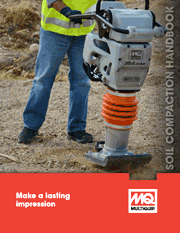
Rammers deliver a high impact force (high amplitude) making them an excellent choice for cohesive and semi-cohesive soils. Frequency range is 500 to 750 blows per minute. Rammers get compaction force from a small gasoline or diesel engine powering a large piston set with two sets of springs. Rammers, otherwise known as jumping jacks or tampers, are the preferred compaction tool of many contractors and excavation companies. The rammer is inclined at a forward angle to allow forward travel as the machine jumps. Rammers cover three types of compaction: impact, vibration and kneading.
 Rammer Handbook
Vibratory Plate Compactors
also known as Forward Plate Compactors
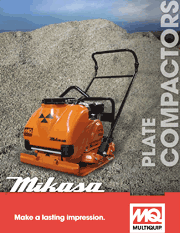
Forward - Vibratory plates are low amplitude and high frequency, designed to compact granular soils and asphalt. Gasoline or diesel engines drive one or two eccentric weights at a high speed to develop compaction force. The resulting vibrations cause forward motion. The engine and handle are vibration-isolated from the vibrating plate. The heavier the plate, the more compaction force it generates. Frequency range is usually 2500 vpm to 6000 vpm. Plates used for asphalt have a water tank and sprinkler system to prevent asphalt from sticking to the bottom of the baseplate. Vibration is the one principal compaction effect.
 Vibratory Plate Handbook
Reversible Plate Compactors
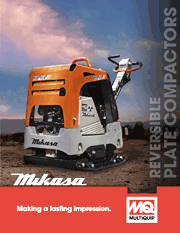
In addition to some of the standard vibratory plate features, reversible plates have two eccentric weights that allow smooth transition for forward or reverse travel, plus increased compaction force as the result of dual weights. Due to their weight and force, reversible plates are ideal for semi-cohesive soils.
A reversible is possibly the best compaction buy dollar for dollar. Unlike standard plates, the reversible’s forward travel may be stopped and the machine will maintain its force for “spot” compaction.
A reversible is possibly the best compaction buy dollar for dollar. Unlike standard plates, the reversible’s forward travel may be stopped and the machine will maintain its force for “spot” compaction.
 Reversible Plate Handbook
Multiquip Rollers
Single-Drum Patching Rollers:
The ideal solution for asphalt patching jobs too small to be handled with tandem rollers. Dependability and performance make these rollers a favorite of contractors, highway repair agencies and municipalities. A fully enclosed hydrostatic-drive system offers infinitely variable speed control, smooth acceleration and braking. Many municipalites use rollers as their preferred asphalt patching tool.
 V305 Patch Roller
 Walk Behind Roller Brochure
Tandem Drum Rollers:
Double-drum rollers easily tackle large asphalt compaction jobs and feature built-in water tanks, hydrostatic drive and spray bars. The MRH800-Series tandem rollers feature a streamlined design that allows access to tighter areas. These versatile rollers are ideal for asphalt patching or compaction of granular soils.
 RammerRack Flyer